The Staunch Calvinist

"Absolute sovereignty is what I love to ascribe to God." - Jonathan Edwards

Search posts


Found 4 results


1689 Baptist Confession Chapter 22: Of Religious Worship and the Sabbath Day - Commentary

!DOCTYPE html

Chapter 22: Of Religious Worship and the Sabbath Day

How are we to worship God? What is the Regulative Principle? Is it taught in the Scriptures? What are the elements of worship? What are circumstances? Are we only to sing the Psalms? Can we use musical instruments in public worship? 

Is there a specific day of worship? What is the Sabbath? Which day is it? When was it first instituted? How is it that Sunday is the Christian Sabbath? Where does Scripture teach the change of the day? What about Romans 14:5-6; Galatians 4:9-11; Colossians 2:16-17? Don’t these passages teach the abrogation of the Sabbath? How is the Sabbath to be kept?


§1 The Regulative Principle Of Worship

  1. The light of nature shews that there is a God, who hath lordship and sovereignty over all; is just, good and doth good unto all; and is therefore to be feared, loved, praised, called upon, trusted in, and served, with all the heart and all the soul, and with all the might. 1 But the acceptable way of worshipping the true God, is instituted by himself, and so limited by his own revealed will, that he may not be worshipped according to the imagination and devices of men, nor the suggestions of Satan, under any visible representations, or any other way not prescribed in the Holy Scriptures. 2
    1. Jer. 10:7; Mark 12:33[1]
    2. Gen. 4:1-5; Exod. 20:4-6; Matt. 15:3, 8-9; 2 Kings 16:10-18; Lev. 10:1-3; Deut. 17:3; 4:2; 12:29-32; Josh. 1:7; 23:6-8; Matt. 15:13; Col. 2:20-23; 2 Tim. 3:15-17

The light of nature or natural revelation as we call it shows that there is a God, Who hath lordship and sovereignty over all (Rom. 1:19-23). That there is a God, no one will be able to deny when they stand before God. Both creation and the Creator testify to God. This is basic Romans 1. Furthermore, this God is just, good and doth good unto all (Ps. 145:9) as evidenced by the things which we have and receive. Therefore, He is to be worshiped and served with the whole of our being. Yet He is not to be worshiped as we like. But the acceptable way of worshipping the true God, is instituted by Himself (Ex. 20:4-6; Deut. 4:2; 12:29-32). It is God Who determines how He is to be worshiped. This acceptable way is limited by His revealed will, i.e., Holy Scripture. The unacceptable way of worshipping God as according to the imagination and devices of men (Acts 17:29; Col. 2:23), the suggestions of Satanvisible representations (Ex. 20:4-6) and any other way not prescribed in the Holy Scriptures (Lev. 10:1-3) is abominable to God and He is not pleased with it. God is not to be worshiped as we think He would like to be worship. Why should we think of ways of worshipping Him when He has revealed how He desires to be worshiped? Neither is He to be worshiped through or by any visible representations. This excludes all images and statues of the persons of the Godhead as well as the saints who according to Roman Catholic theology can act as intercessors between us and God/Jesus. The most important aspect of what is called the Regulative Principle of Worship is expressed in the last clause: any other way not prescribed in the Holy Scriptures. Not only is He to be worshiped according to His revealed will, but He is not to be worshiped through that which He has not revealed. If it is not prescribed in the Holy Scriptures, it should not be an element of His worship. If it is prescribed in the Holy Scriptures, it should.


There Is A God

Creation testifies to everyone with...

Resources for studying the Christian Sabbath

Written Resources

  • Philip S. Ross, From the Finger of God: The Biblical and Theological Basis for the Threefold Division of the Law (Fearn, Ross-shire, Scotland: Christian Focus, 2010).
  • C. P. Arand, C. L. Blomberg, S. MacCarty, & J. A. Pipa, Perspectives on the Sabbath: Four Views, ed. C. J. Donato (Nashville: B&H Pub., 2011).
  • Joseph A. Pipa, Jr, The Lord’s Day (Fearn: Christian Focus, 1997).
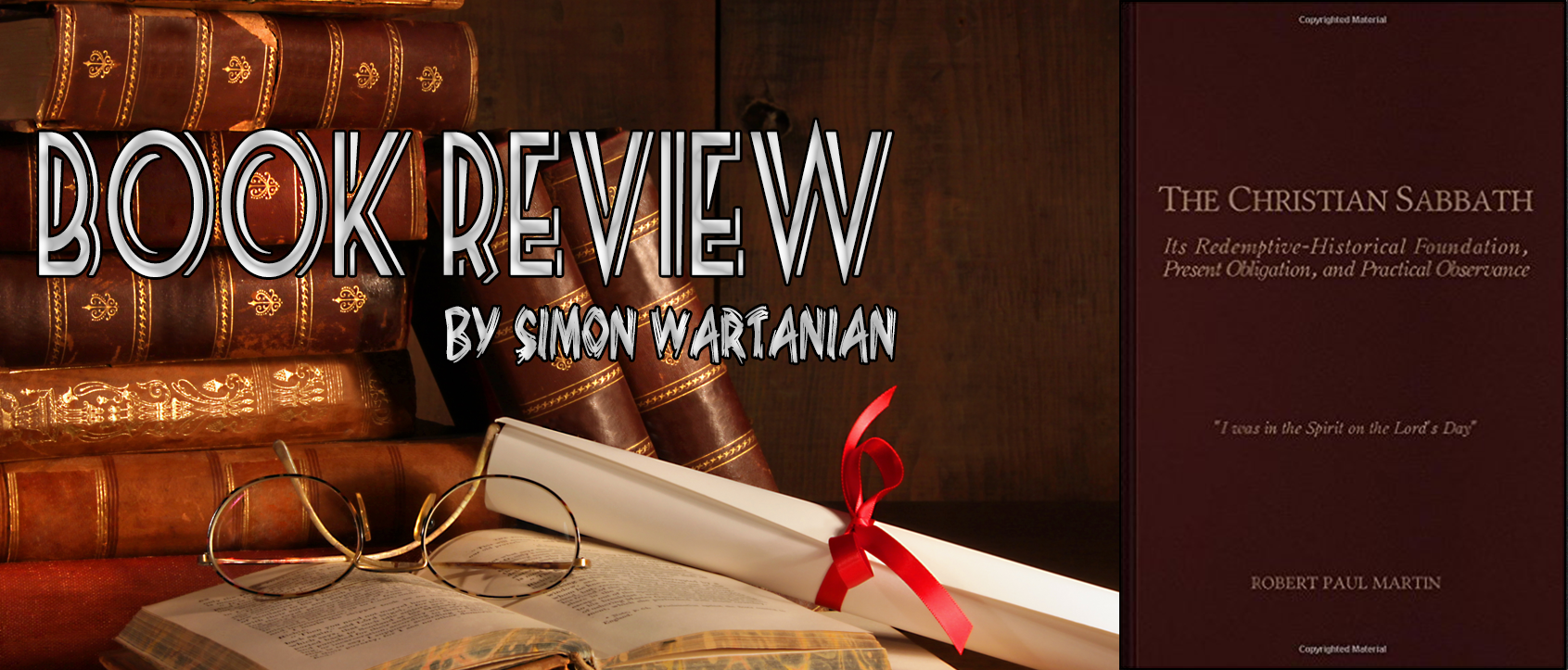
  • Robert Paul Martin, The Christian Sabbath: Its Redemptive-Historical Foundation, Present Obligation, and Practical Observance (Trinity Pulpit Press, 2016).
  • Francis Nigel Lee, The Covenantal Sabbath (London, ILQ: Lord’s Day Observance Society, 1974). Available at http://www.the-highway.com/Covsab_TOC.html.
    • This is a very extensive work on the Sabbath, which is out of print, but available online.
  • John Owen, A Treatise On The Sabbath (Forgotten Books, 2015). A photocopy edition, which is also available online at https://archive.org/details/treatiseonsabbat00owen.
  • Richard Barcellos, etc, Going Beyond The Five Points, ed. Rob Ventura (San Bernardino, CA: [CreateSpace Independent Publishing Platform], 2015). pp. 53-56.
  • Richard Barcellos:

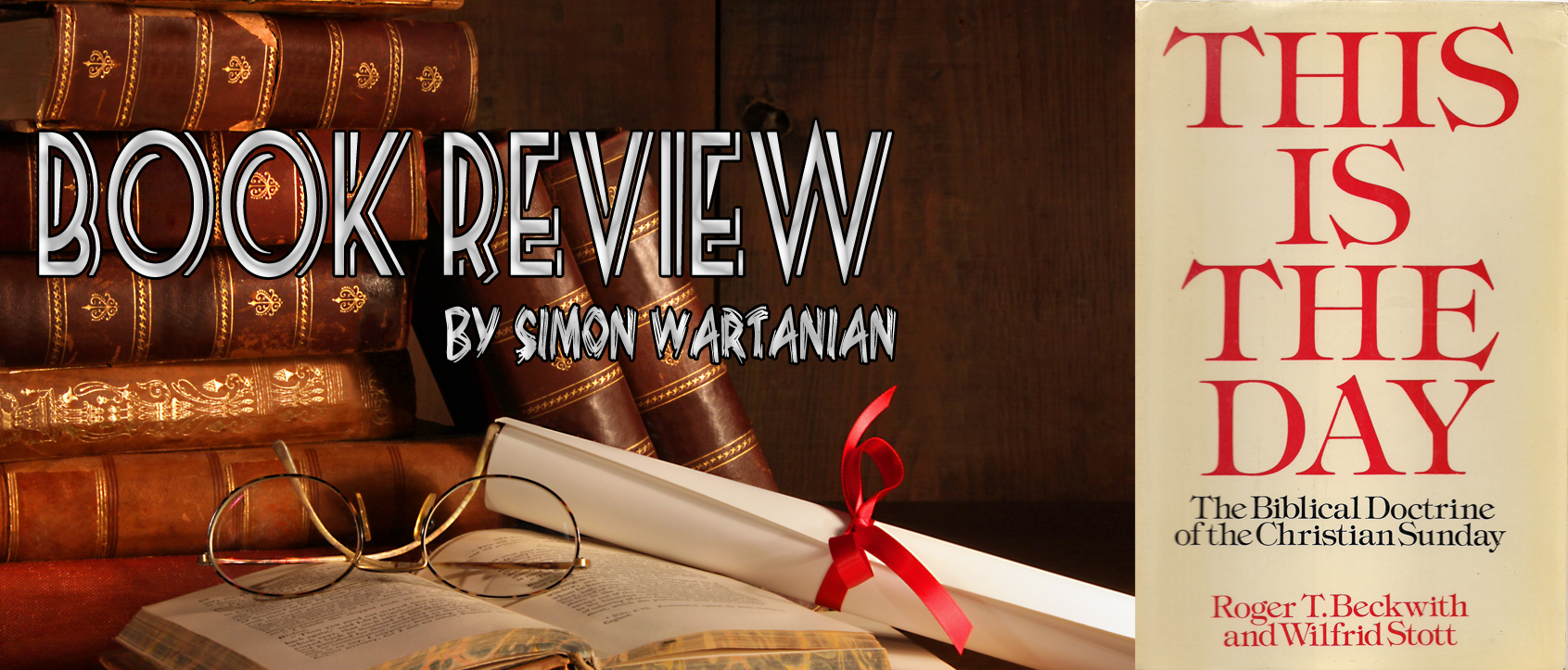
A Short Review of Beckwith's & Stott's This Is The Day

.... Beckwith and Wilfrid Stott

A well researched book by two readable authors. Makes a convincing and honest case from both the Holy Scriptures as well as the first four centuries from Christian history.

The biblical case is short and to the point. I love the fact there is always reference back to what he has said or established on earlier pages. Roger Beckwith goes on to demonstrate that the Sabbath was a creation ordinance and as such it is not connected with the Fall. Then he goes on to survey the passages speaking about the Sabbath. Very interesting was chapter 4 where he showed continuities between the Jewish Sabbath and The Lord's Day (the Christian Sabbath). He makes the case that The Lord's Day is the day of the Lord Christ, the day on which He rose and which we keep to celebrate His resurrection. The first part was very well written and argued, although I would have liked it to be longer and more extensive, but oh well!

The second part has 9 chapters devoted to a historical study about the Sabbath and The Lord's Day. It is very interesting to many how many early references there are to the Christian observance of The Lord's Day as the day of worship. The New Testament has a handful of passages speaking about The Lord's Day (first day of the week), but apparently, in the mind of the early Christians, these passages were a firm foundation to show them that Sunday was the day of worship, the kyriake hemera! Dr. Stott makes a good survey of various pre-400 AD writings in these chapters. There are things which the Fathers believed that I don't agree with, neither do Beckwith nor Stott. But they are honest to lay out their views honestly and clearly. For example, although the observance of The Lord's Day is directly connected to the Fourth Commandment in the mind of the Christian Sabbatarian, the early Fathers, according to Stott, do not make a direct connection with it. As Christian Sabbatarians we believe that the Sabbath was instituted in the Garden and given to Adam to keep, but the Fathers did not agree or say that Adam had to keep a Sabbath, but some of them connected it with the existence of sin (i.e. trouble, sin in our lives and the need for rest). Stott lays these views out honestly and makes some observations on them. It is still amazing to me how much Christians wrote and said about The Lord's Day, although there were but a handful of passages on it in the New Testament. It goes to show that what is insignificant in our modern eyes, was more than enough for the early church. It was enough that the Lord Christ rose on The Lord's Day, for The Lord's Day to be considered the day of rest and worship--a holy day.

His chapter on Eusebius of Caesarea (8) is very interesting. He tries to demonstrate that Eusebius tried to systematize and summarize the doctrines about The Lord's Day and the Sabbath which the Fathers taught. He was the systemizer of the Christian Sunday. He speaks of the Lord transferring the feast of the Sabbath to the first day and so on. Clearly connecting The Lord's Day with the Sabbath.

Overall, a very good and well argued book. I will certainly go back to it and check some stuff again!

Seeing that this book was published in 1978 it would be hard to come by, but fear not! An online (scanned) version is available here

...

A Review Of Robert Martin's The Christian Sabbath

...c/post/etc/Dr-Martin.jpg" />

Until now he had not made a case for the change of the day. His book was about the Christian Sabbath, but what he argued for until now was the seventh-day Sabbath. To be sure, he made passing remarks on the change of the day. But he treats the change of the day in two chapters. The first one is dedicated to "the Apostolic Witness" where he examines the resurrection and the resurrection appearances as the prime reason for the change of the day, the day of Pentecost (Acts 2:1), the gathering of the church on the first day to break bread and have Paul preached to them (Acts 20:7), the gathering of alms on the first day (1Cor 16:1-2) and finally, The Lord's Day (Rev 1:10). In my opinion, he makes a good case for the change of the day from these passages and also from his treatment of the abiding Sabbath from Hebrews 4:9.

Then he moves to the post-apostolic testimony to The Lord's Day. He notes that often the word Sabbath was retrained for the Jewish Sabbath and was not frequently used for Sunday. Rather, from the earliest times, the expression "The Lord's Day" was used for the first day of the week on which Christ rose.

Finally, he moves on in the last part (3) to teach us how we should observe the Sabbath. He is careful in his suggestions and what He may say and deduce from God's Word. His desire is not to bind consciences where God has not bound them, but carefully give guidelines and suggestions.

Overall, I very much enjoyed reading this book and I used it a lot in my own study for the 1689 Baptist Confession's chapter 22 on the Sabbath (sections 7-8). It is detailed, it is biblical and it is written in a loving and respectful tone. What more can we expect? Get it and read it already!

...